Sunday, February 17, 2013

Speedpaints Update

Decided to post a couple of speedpaints I did this evening to try and relieve some stress that's been piling up throughout the week due to various school projects and such. Guess you could consider it a form of art therapy.

Saturday, February 16, 2013

WORLDBUILDING: PART 6

A B R I D G E D   W O R L D   H I S T O R Y
LAYING THE GROUNDWORK

When we last left off, we had finally developed the rudiments of our somewhat complex world theater in Dragonsgate. It's been somewhat of a daunting task to develop the particulars of this quasi-historical world, but I think it's really starting to emerge with a clear, articulated shape. Within the next two steps (perhaps 3), we'll really start to see some layers of realism take shape.

In this article, I'll explore some of the major historical events that have occurred in Dragonsgate within a reasonable time-scale. This will include geological events (ie. catastrophes or significant shifts in weather patterns, such as a major drought or an ice age) as well as Events of Civilization (major historical occurrences - battles, treaties, discoveries etc.).

For starters, how did things begin? We can really explore two possible routes: (1) a supernatural creation mythos centered around the dominant pantheon of deities in the world of Dragonsgate (extant deities, not defunct ones); and (2) a more geological, scientific-oriented method. Given that we've already been treading the line between possibilities thus far, I think it's within reason to say that, given the level of realism I'm aiming for, why not go through the planetological particulars of the world and its evolution AND create a mythological genesis legend to accompany it. That we get knowledge about the world itself and some elements of its culture.

 A planetary nebula - how a galaxy gets the ball rolling.

Also, planetology really is a word. It's most recognized in fiction from Frank Herbert's Dune (If you haven't read it, I highly recommend it. A bit tricky to navigate, but very conceptually relevant to our ecologically frail era).
plan·e·tol·o·gy  (pln-tl-j)
n. The branch of astronomy that deals with the planets of the solar system.
So, we've established that the planet on which our setting finds a home was established through the conventional means of gradual aggregate assembly by way of a planetary nebula or some other such gravitational phenomena of comparable potency (that's getting a bit too "beyond what's necessary" I feel, so I'll keep moving). For the purposes of creating a world that isn't too alien or bizarre, we'll say that for all intents and purposes, this planet is a Class M planet (for those of you unfamiliar with the nitty gritty of Star Trek and its numerous intricacies:  Class M Planet ) with all the usual amounts of Oxygen, Nitrogen and Water to make life comfortable and, well, normal.

I mentioned that we'll have a creation myth to go along with things, but at the moment, we've still yet to explain the history leading up to the modern era of Dragonsgate, so let's not jump too far ahead of ourselves. All in due time.


There is always a cradle of civilization to consider, and it creates a logical starting point for humanoid history, even if all the races aren't necessarily related. Also, the fact that we have more than just humans here does complicate any "creation myths" associated with the presence of sentient life on this world. We'll have to, as necessary, explain the presence of each of the different peoples of Dragonsgate.


I think things really should begin with the following considerations: (1) this is a low-magic setting (exploring the 'why?' behind this fact); (2) there is a society of reclusive tieflings that are associated with the bottleneck in magical power; (3) is the status quo of the world stable or turbulent? Considering this will help me lay the foundations for historical events that contributed to a predominant era of peace or discord, respectively; (4) how active are the gods or divine agents in this world (if at all)?; (5) what point in the history of the world is our setting going to be focused? We need to know how far along the world has come if we're going to explore what has happened in the intervening time between Now and the Beginning; (6) what is the health of the world at large? Are we looking at something primordial? A world in its infancy? Or are we looking at a world that has seen much, much history in its time with successive ages and eons fading to distant memory, approaching its inevitable end?


Related to that last point, that brings up an interesting issue. This is probably something I should have explored in more detail in the early stages of the worldbuilding process, but hey, hindsight is 20/20. There is a setting called Dawnforge that addresses a world in its primordial state, though, it frames the world as a more classical setting, a very fantasy-veneered take on a more mythological world, like those portrayed in Clash of the Titans (the original 1981 version) or something more modern, like Immortals or the God of War videogame series. Worlds like this have a very real, very visible footprint from the gods and supernatural elements are mundane, powerful and terrifying for everyone that witnesses them. Running a campaign in this vein is very much an Age of Legends. Alternatively, you can push the clock back even further, designing a setting that is very much prehistoric in nature and scope, becoming almost a Land of the Lost or Beastmaster inspired world. While those would have too little history to be viable options at the moment, they do create interesting possibilities for parallel worlds in the greater cosmology of Dragonsgate (something we'll have to look into a bit later). 
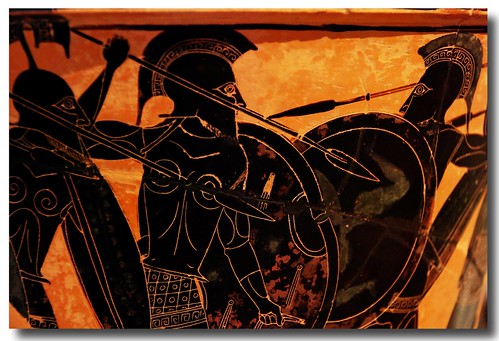
 Greek hoplites depicted on an ancient piece of pottery.


Addressing the other end of the spectrum, is a world that is in decline, such as that seen in Jack Vance's Dying Earth series. In those works, the sun is in the final stages of its life cycle and the earth is very, very old. It makes for a very bleak setting with a wash of nihilism coating everything. One of the major advantages of this kind of setting is the shear abundance of rich history and strange, inexplicable devices or ruins. Things could be present which literally cannot be explained or analyzed because there is no one alive with knowledge of the events and even the recordings of such events have long since been reduced to dust or lost to some severe catastrophe. Another interesting possibility is blurring the lines between magic and technology, so much so to the point that they are almost indistinguishable from one another, and to the people of such a world, there is no reason to understand a difference between them. For example, in Gene Wolfe's Book of the New Sun, one of the guild's in his setting uses a device that generates 'lightning' which they use for purposes of torture. Mystified, they use this 'magical' device without understanding something as fundamental as electricity. It's a paradigm-shifting concept - that, if the knowledge of what electricity is and how it acts in the universe is forgotten, we immediately revert to our ancient, natural state of clouding the unknown with the Divine. Interesting notions to consider, of course, but unfortunately, I've spent far too much time and space on this matter - much more than I wanted to. To condense all of that, I will continue my Middle Path ideology and explore elements of both. Dragonsgate will be an older world, but one that is just starting to climb another peak on the sinusoidal path of its world history. Literally starting fresh, in a way. It won't be primordial, but much of the history of the past cycles will be buried in the Substrata of Time.
Book of the New Sun, Part One  for those of you that are interested.
Moving on, I want to consider the other points that I brought to attention a couple of paragraphs ago. This is a low-magic setting, something that is easily justifiable enough considering the age of the world. Perhaps magical energy/fields/powers ebb and flow with the cycles of the earth's age. I like that notion, and I'll say that in this particular cycle, magical activity is at a low. On top of that, it is something that is safeguarded. I like the idea of magical power being a Pandora's Box, so, I'll say that unstewarded use of magical powers contributed to the catastrophe that ended the previous cycle of the world's history. The tieflings that guard the mystical well I'd mentioned in Worldbuilding 4 need to have a reason for doing so. Tieflings are not necessarily evil, so I don't like the idea of them selfishly hoarding the access to magical power for no reason other than the fact that they are vile and depraved. No, I actually think that the tieflings will be the survivors of the previous apocalyptic event, and their diabolic nature is a mark of the gods they are marked with as punishment for their hubris and misuse of magical power in the past. This simultaneously addresses points 1 and 2 and also creates a lot of mythological fodder for later.

For number 3, the status quo is always turbulent. Always. For a campaign, it can start in peace-time or otherwise stable eras, but that needs to change quickly. This is also a good rule of thumb for any fictitious story. Stable is boring. People don't read (or in the case of a game, play) something because it is static and blissful. I'm not saying that the world needs to be on the brink of utter destruction constantly (unless you're running Die Hard: the CamPAIN), but something needs to happen, and quickly. The best way to grab your players' (or readers') attention is to throw them into the deep end, fast.

In regards to (4), I say that gods will be minimally "active" in the worldly affairs - after all, they're probably jaded after seeing the world be blown up not too far ago in the past. They might keep a watchful gaze on the doings of the newest denizens of their world, but they may be waiting to see how things begin to play out. I do like the idea of them occasionally walking the earth disguised as mortals to keep informed about the health of their precious world. Also, they would probably want to keep tabs on the access to magical power to ensure that the past doesn't repeat itself. And lastly, we've already addressed points (5) and (6) with my lengthy discussion just a little while ago.

So...now that I've spent far longer just laying the groundwork for my discussion of Dragonsgate's history, I'll try to keep the rest of the post to a minimum and break it up into a second post detailing the most major events (mainly to spare you readers from going cross-eyed staring at the screen for too long).
  1. The Great Mishap. It won't be called that, but it needs a suitable placeholder name for now. This will be the event that caused the end of the previous age of the world. It needs to be sudden, violent and dramatic. I think a battle or other major threat should be involved - maybe a monster or alien entity of considerable power that was defeated only at the cost of accidentally destroying the world itself. Maybe a Cthuluesque monster or the infamous Tarrasque was responsible. It could have even been a Godzilla or Cloverfield situation. A cadre of brave spellcasters set forth to stop the threat and unleashed a Pandora's Box spell. Tragic irony. In fact, I think I have it. A powerful villain's plans were nearing the dramatic crescendo, and the world was almost in his hands; a powerful group of heroes stepped up to stand in the villain's way, calling upon potent magic to thwart their enemy. But the spell was too potent and perhaps too poorly understood. The spell succeeded in stopping the enemy, but only because a more powerful and more uncontrollable entity was summoned through the dweomer. Ultimately, this entity would probably be some sort of terrible, Lovecraftian entity that devoured the denizens of the world or reduced the survivors to madness before departing back to the Far Reaches of the Cosmos. Now that it knows the location of this world, it could return, any day, to continue its rage.
  2. The War of the Nine Wands. Not too sure where this fits, but I'm digging the name. Automatically it has something to do with magic, and the name makes it sound suitably epic and dramatic. Perfect for a major event. This does imply that it takes place before the Great Mishap, though it could also be early on in the New Era before the tieflings stake out and control access to the Well.
  3. The Northern Exodus. This could be the event that explains the concentration of nations and people around the mid-latitudes of the world. It could also be precipitated by the Great Mishap. Still, it's getting difficult to envision how new races that would have been unaffected by the Mishap would be able to spread through new areas of the world without knowledge of the previous events or era. Maybe the gods seeded new races in the New Era. I dislike the idea due to its supernatural feel, but it might be possible to "rationalize" it. I doubt it though. Maybe the tieflings created new races to act as their successors, perhaps in an attempt to seek out penance for their previous wrongdoings. Although, if I go with the Great Mishap incident, this is hardly an act worthy of cursing the individuals responsible. They acted out of good intentions, but achieved disastrous results. Perhaps the tieflings that guard the Well are not an entire community or city, but just a cadre - the original heroes that were responsible for the summoning to begin with. Maybe the survived and were punished for their crime of using forbidden magic to summon an entity beyond their control. I like that - lots of layers. It's easy to see that we're fueling a lot of mythical elements into the early history of the second age though. Oooooh. Idea. Not sure what the technology level of Era One (prior to Era Two, aka the New Era), but what if there was a 'genetic ark' of entities that were being constructed or engineered (this is starting to become a science-fantasy setting) by the previous population prior to the Mishap and the surviving tieflings used those samples to introduce new life-forms to the broken, charred world of Dragonsgate? I'm starting to feel like there's a vein of Prometheus going on here, which is all well and fine. It's worthy of exploration later, but this could explain the vast diversity of races on Dragonsgate, their relative close proximity and distribution to one another and it also creates another ethical issue for which the Precursors (tieflings) could be held responsible and judged for their 'hubris'.
  4. The First Council of Nations. From the get-go, I liked the idea of the nation of Pazu being a highly peaceful and diplomatic nation, defying the typical trope of making orcs, goblins, trolls and ogres mindless, evil and depraved entities. Given the nature of the world, I think it's somewhat appropriate to have the paradigm inverted a bit (ie. a lot). Nevertheless, it would be a landmark event to note when all the major nations of the era convened to establish general protocols and relations with one another. It's not necessarily saying that the times since the first council have been sunshine and butterflies entirely; it's more interesting that it creates the possibility for a tense, dynamic, political theatre that can create and exhibit numerous sources of intrigue and political strife or tension. Those are great plot-points for any story and create a natural way to discuss the status quo of the world.
  5. The Construction (and War of) the Librams. No idea what this is yet, but it sounds good, whatever it is (yes, these are mostly just ideas that are coming to me as I write).
  6. The Maradi incursion; the Andujan unification; the division of the crown of Algard into the Kingdoms of Seagate and Windmarch. These are a few major political/historical events that need to be discussed at length, and I'll discuss them next time.
Next time, we'll dig right into discussing these 6 points, which should give us a pretty good basis for resting Dragonsgate's status quo upon.

Saturday, February 9, 2013

Materials + Methods: Bimetallic Strips

In biology, there are numerous examples of systems intrinsically keeping themselves in balance (bonus point: if the word "homeostasis" jumped into your brain, you get a gold star) through feedback loops of various degrees of complexity. Feedback loops, in and of themselves, operate through mechanics that can be simulated or imitated in artificial methods. We see this done everyday in mundane devices, and sometimes it scarcely even dawns on us just how important it is that systems are capable of self-regulation without human input or intervention.

The notion of incorporating this concept into the built environment is something appeals to me greatly, and with any luck, I'll be able to work toward my thesis exploring this notion. However, my research goals aren't the point of this article. It's about creating smart buildings. Structures that can self-regulate critical functions and possibly even due so without requiring power in the traditional sense. Thus, self-regulating buildings represent a particularly inviting paradigm-shift in the modern setting - a structure that can reduce it's ecological footprint and increase efficiency.

I have no doubt that there are other materials that are capable of being applied to this sort of system, but for now, the material I want to talk about are thermo-bimetals, or more accurately, bimetallic strips. These are comprised of two strips of different metals that are bolted, welded or otherwise permanently connected together. Each piece of metal has a different coefficient of thermal expansion, which causes them to act in opposition to one another as the unit is exposed to heat. 

At this point, I think a quick explanation of the mechanics is in order. So, they have two different coefficients. So what? Well, to put it simply, as the metal unit will expand and bend one way if exposed to heat (due to the coefficient of one of the metals) and will contract and bend the other way if cooled to a point below the baseline temperature. Therefore, we have a system that can react in two possible directions based on a gradation of a particular stimulus (heat, in this case).

We see these in use in everyday items such as a typical thermostat, which uses the difference in expansion coefficients to trip the circuit responsible for heating your home when the ambient temperature becomes too cold. Also, the materials used are typically steel and copper, which makes these devices somewhat affordable for any potential architectural applications. 

Speaking of architectural applications, what are they exactly? Glad you asked. Ironically, it's not just a coincidence that bimetallic strips are seen in use in thermostats - they also possess a remarkable potential for regulating the interior temperature of a building. Imagine a lattice or even a wall woven out of bimetallic strips. If the interior temperature becomes too hot, the strips will deform and create an aperture that allows for air ventilation and circulation, thereby cooling the room back to baseline and causing the strips to return to their original state. Boom. Feedback loop. 

It's amazing to see how a biological concept can translate so well into a potential tool for the built environment.

As a caveat, I'd like to say that I have practically zero knowledge when it comes to the statics of these materials or any of the actual engineering parlance and technical jargon that would be required to implement such tools in practical use. But then again, the first step is often simply identifying a potential solution. The details will work themselves out, usually. However, I simply wanted to bring this sort of possibility to the attention of anyone out there with a vested interest in the architectural field. The scope of reality in the built environment is changing just as rapidly as the world around us. Finding solutions that can work smartly, effectively, and yes, as the risk of sounding passe, sustainably, is not necessarily the necessary choice, but the wise choice.

As they say, work smarter, not harder.

Also, if anyone is interested, there is an architect at USC who is doing a substantial amount of research into this concept - Doris Kim Sung. There's a video of her explaining her research and the applications of thermo-bimetals on TED, which I will provide below:


I hope to write additional posts on other unusual materials and methods later in the future, but I figured this would be a good place to start. These are the sort of things that captivate the imagination of both designers and any people that come to a place, I would think. Definitely feel free to post any suggestions about other ideas to explore or take a look into - I don't mind researching new and exciting things.


Sunday, January 27, 2013

WORLDBUILDING: PART 5

N A T I O N B U I L D I N G


When we last left off, we had identified the composition of our world's population(s), but stopped just short of figuring out exactly what sort of countries and nations said people had arranged themselves into over the vague timeline of Dragonsgate. Again, we must plot forward without knowing much about the history of our little brainchild, but fear not, we will get there eventually.


So, what now? We have 7 proto-nations to develop. Right now, they're little more than occupied sites. We need to pay attention to the characteristics of the regions we've already identified (1-7) and also factor in the population choices we decided upon last time. A couple of the proto-nations already have a rough identity associated with them and now all we need to do is hammer out those details. The more defined proto-nations would therefore be the most logical starting point. If we need to make adjustments to their identity/characteristics after fleshing out the remaining nations, then it's a fairly easy process to make minor adjustments/modifications.


Here are the nations we know we have:

  1. Anglo-Saxon nation
  2. Teutonic nation
  3. Iberian nation
  4. Middle-eastern/Mesopotamian nation
  5. Orc/Goblin/Troll nation

This technically means that we have five figured out (roughly), but the remaining two will also have to be figured out, unless it's determined that they're some form of dominion of one of the other five (which is possible). We also know that we have a tiefling city/state to place somewhere as well as a fairie/fey, forest-kingdom to set up, and the location of those areas will be largely determined by the identity of their surrounding neighbors (I believe the the tiefling city-state should be established around the regions labeled as 6 or 7, probably up in the mountains, since they, you know, guard the secrets of magical power and such. The forest between Regions 4 and 6 has my eye as being the potential location for the Fey Kingdom. I'm also thinking that a collection of druidic tribes and other exiles from civilization might have made their home in the large forest the west of Region 4


Also, once we have these nations finalized, we can start naming specific regions and locations so they're not simply referred to by such vague terms as “the northernmost woods” or the “northern sea” or “the large river that runs through the southern desert”. That will make things significantly more interesting, but it's still a little ways off. Climb one mountain at a time and such.


Region 4 is going to be the Anglo-Saxon kingdom. I'd like to keep the Anglo-Saxon kingdom and the Teutonic kingdom in as high a latitude as possible, and therefore, Region 6 is the Teutonic kingdom (and the tieflings will inhabit the long mountain range just to the South). Region 2 is going to be the Iberian nation, and at this juncture, I'm very certain I'm going to model it after Spain, just after the Reconquista. Therefore, Region 2 is going to be modeled after the Islamic Caliphate of Córdoba (or the kingdoms of Al-Andalus) (with its capital modeled after the city of Córdoba itself, (and likely Granada as well) thereby giving it a distinct fusion of Moorish and European medieval aesthetics).

 
La Rendición de Granada, Francisco Pradilla y Ortiz, 1882,
That leaves us Regions 3, 5 and 7. I think Region 3 is a good location for the Orc/Goblin/Troll nation, as it is isolated from the other nations, and it is not too hard to believe that human settlements would distance themselves from such monsters and that such a xenophobic sentiment might be mutual from the orcs/goblins/trolls. Nevertheless, it would also be highly entertaining if this kingdom had a significant degree of diplomatic or trade power to exert on the rest of the civilized world. Maybe they even helped form a treat between the belligerent countries of 1 and 2 at some point. These are some rare chances to add some flare and flavor to your campaign setting – that is to say, finding ways of turning stereotypes (particularly fantasy tropes) onto themselves. You never know how you might create an interesting story element for your campaign setting just by thinking of a simple way to shake things up. It doesnt have to be cleverly inventive; the simple tricks often work the best.


Now, regions 5 and 7. I think that Region 5 should be a seafaring kingdom/mercantile nation that sould be heavily influenced by its larger neighbor to the North (2), but should retain a considerable amount of autonomy due to its economic power. Alternatively, it could long ago have been beset by Nation 2, representing an irresistible opportunity to gain power and wealth (as most economic centres of the world are wont to become). Regardless, the mountains between 2 and 5 are going to be sheer and treacherous and any protracted military campaign across their summits will be expensive and likely to meet in catastrophic failure, so it's a good bet that Nation 5 is independent and safe until 2 can figure out a way to get across the peaks. Right now, Portugal sounds like an excellent precedent to loan to Region 5, and I'll work with that for the time being.


7 is going to be the tricky one. The area is filled with sounds, fords, lakes and other large inlets from the sea, which immediately conjures imagery of a Nordic society; however, as I've already decided that I want 4 and 6 to represent the Anglo-Saxon and Teutonic countries, 7 doesn't really get that option. And I want the Teutonic country to abut the Anglo-Saxon country, so that doesn't really leave too many options. You know. That gives me an idea. Perhaps the Sea traversed by Teutonic settlers from Area 7 and led to them settling in Region 6 and eventually Region 4 before being thwarted moving downward in droves by the mountainous barrier between the northern latitudes and the more temperate central region of the land. That would mean that 4 and 6 were really part of one kingdom, but could reflect two sub-kingdoms, much like the real Anglo-Saxon era England was. I like that notion. It creates opportunities for petty lords and sub-kings to wage their own wars with one another while the King himself struggles to maintain order in his squabbling territories. This also gives the Teutonic kingdom some degree of isolation and could magnify the importance of the mysterious tieflings in their culture. In fact, the more I look at it, there is a large unoccupied island in the middle of the northern sea. This might be the perfect location for the tieflings and their mystical well of magical energy.


So it looks like I've successfully mapped out my kingdoms and regions. Now it's time for some political boundaries, which means more map-making. So, I open up our trusty map again in Photoshop and select the “Overlay” layer that we established a while ago. Firstly, I'll run Edit > Stroke on the inside of the layer. I choose a somewhat conspicuous color – purple in this case (hex 7a2a97) set at an opacity of 70% and a thickness of 5px. It's also important to create a new layer before applying the stroke; I create a new layer titled “political boundaries” and apply the stroke on this layer (we just used the overlay layer to get the correct region selected).

Our layers so far.

The stroke will probably look a bit jagged and unappealing, so just run a gaussian blur filter over it (set to 1px) and that should take care of the problem. Now, it makes the most sense to have 4 be bounded by the rivers surrounding it (rivers have always been important historic borders), so I color those in using the brush, essentially just tracing over the rivers. I decide the southeasternmost boundary will run all the way to the most distal artery of the river, literally abutting the fringe of Nation 2. 

According to my settlement map, this area is very heavily populated and as such, we can conclude that this area is perhaps hotly contested between the nations of 4 and 2, with some of the most economically viable cities of 4 located on one side and the likely seat of the government for 2 located on the other side. Perhaps this border is even a site of continuous battle. Maybe the settlers on either side of the river have seen the land change hands far too many times to be concerned with issues such as “nationality”. It's a possibility. I'll move onto 2 now, as they present an interesting problem – there is no definitive boundary between 2 and 1, which leads to the question of how and why did they determine to have an arbitrary border between the two countries? Otherwise, the borders for 2 are delineated by the mountains that surround it. That's when it hits me; 1 will be a tributary state to 2, much like the real Caliphate of Córdoba became after the Christian kingdoms of Northern Spain beset it. 1 will retain a significant degree of autonomy, but ultimately defers to 2 in political and commercial matters. This also considerably expands the resources available to 2 as a kingdom and is starting to give the impression that it is the dominant power in the Theatre of the Realm here (particularly as 5 serves as a de facto trade outpost/ally to 2 and is all but entirely out of the reach of 4. 4 will likely rely on a steady trade relationship with the Merfolk kingdom that I had mentioned in the previous post. 6 probably trades regularly with 7 and 3 might risk trade with 1; or perhaps there is a trade agreement between the dwarves in the mountain range between 3 and 1, part of an intensive effort to maintain peace and stability in the area (particularly if I continue with the idea of making the Orc/Goblin/Troll nation one of consummate diplomats). For the time being, even though 1 is a tributary state to 2, I create an artificial border between the two regions, mainly for my own purposes at understanding the outermost limits of 2.


After drawing these borders, 5 is already contained within its boundary against 2, 1 and the ocean; and 6 has also been locked into its borders between 4, 2 and the sea. I finish by drawing a border along the river that straddles regions 7 and 3, making that the border that defines those two countries. Looks like our political mapping is done. I make the political lines thicker by running a 5px stroke on the boundaries layer.


As we move forward, I'll drop the opacity on the political boundaries so they don't obstruct the image on the whole; but for now, we need it to visualize how everything is fitting together.

 Political Boundaries


To finish today's post off, we'll start brainstorming fitting names to match with our countries. I've already brainstormed a few that sound quite usable, but even if it comes down to only two potential choices, it still makes it incredibly difficult to pick what an entire nation should be named. I'll attempt to do my best for now, but I'm incredibly picky when it comes to names, so this may be a bit more intensive than you might initially think.


  • Our Caliphate of Córdoba knock-off/tributary state to Nation 2: we need something that has a Moorish or Muslim flare to it but without overtly plagiarizing a real-world source (though obscure ones are acceptable). So far, I've come up with Marad, Arahim, Vasir, Jaffa and Jetar (the latter two of which have a soft 'j' sound as in bonjour). I'm leaning toward Jetar at this point. Though, Marad does also have a very appealing sound to it. I'll go with Marad. In this invented language, I decide that it translates as “Sea of Sands”. The Emirate of Marad? The Caliphate of Marad? The Caliphate of Marad. Done.

     A view of how I imagine Marad to be. I'll search for imagery and scenes that depict the various areas of Dragonsgate later on. Probably in a "World Tour" post of sorts.

  • Our post-Reconquista Spanish nation: I've invented a couple of names that sound fitting – Andujas (I like the resemblance to barajas) and Terrego (I like the use of terra as a root), both of which have an appropriate sound. Also, I like the idea of making the name of the capital city Alatriste, a nod to the infamous Captain Alatriste, main protagonist of the works by Arturo Perez-Reverte (which, if you like swashbuckling adventures, I highly recommend). Not to sound biased, but Andujas/Terrego is already sort of becoming my favorite. In fact, I'm going to name the country Andujas, leaving Terrego to become a prominent city in the land. In this world, Andujas means “Burning Winds” as the hot siroccos from the deserts of Marad and the wastes beyond the oases that sustain the desert kingdom roll over the Kingdom, creating its characteristic temperate, dry, chapparal climate.
  • The Orc/Goblin/Troll nation (which I am getting very tired of referring to it as) desperately needs a name. But that's a lot of different monsters to reconcile with one another, so I might go with a name that can be easily translated into the “Common Language”, something that they would likely always be referred to as by outside nations but would probably disdain themselves (after all, they are, if anything, poorly understood as a nation). After considering this for a while, and remembering that the Region 3 sits upon rapidly escalate to a cold plateau, I decide to call the region Pazu, which literally means “the Plateau” in Orc (yes – I just made that up right now. I don't know orcish. However, there are Tolkien scholars that do).
  • The Anglo-Saxon kingdom needs a name that sounds very Medieval and quintessentially English. As such, it might be a literal name such as Wessex or Sussex – literally West Kingdom and Southern Kingdom respectively. I like the name Windmarch, and I reason that the name alludes to the oceanic breezes that pass over and through the mountains that converge at the peninsula of Windmarch.
  • For our pseudo-Portuguese trade hub, I have it down to the names Ferrago and Contão. Both sound Portuguese, or at least vaguely so. Ferrago sounds the stronger of the two, but I think that Contão should still see service as another city.
  • Following the logic for Windmarch, we'll employ a name that fits to the geographical identity of the country. Seagate sounds like a good name, and appropriate given how important the northern sea is to the relationship between Seagate and the Teutonic nation.
  • Finally, we have only to come up with a name for the Teutonic nation. For some reason, Eindhoven comes to mind. It sounds good and seems to fit with the rough regional identity. Eindhoven it is.
Now we have our country names and we can really start jamming ahead with this campaign setting. Everything from this point is finer details that will serve to enhance the clarity of the setting and make it more servicable for active Campaign Duty. Next, we'll start delving into the history of Dragonsgate and investigating the nomenclature utilized for the rest of the geographical features, such as the woods, mountains, rivers, lakes, seas and sounds.


The current map looks very bleh, in my opinion. But that's mainly because it's meant to illustrate a few crucial pieces of information at this point, all of which are easily hidden or removed as necessary. Anyway, here's what we have so far:


Cheers until next time!


Saturday, January 26, 2013

WORLDBUILDING: PART 4

T H E   P E O P L E   O F   D R A G O N S G A T E

There's a lot to be covered when it comes to the people and civilizations that occupy any world you create. Not only does the interplay of various cultures create the possibility for intense conflict (which can be rich fodder for a campaign or story) but it also implies an intricate drama of history that has taken place over the ages (which can also fuel plot-points for a story in addition to layering more realism to your nascent world). It's this dynamic that needs to be carefully considered. Often, in my campaign worlds, the only major race found across all continents is the human race. These are usually based off of different real-world cultures (as we'll see below), but sometimes it's not as easy as that. For the Dragonsgate project, we've been trying to incorporate a more traditional/canonical experience, and this obligates us to include at least some of the stereotypical fantasy races (ie. Elves, dwarves, gnomes, halflings et al.). Each of these additions forces us to consider just how that race plugs into a niche of civilization, requiring its own history and purpose.

Some designers assume that a utopian panoply of creatures and peoples have meshed into a hegemonic civilization at some point in the world's history. There is nothing wrong with this approach, though it may strain the ability to be credible. There certainly is no wrong way to populate your world – it's your world after all. Do what seems the most fun (or whatever best suits your design intentions). 

The first step I take in figuring out what kind of people inhabit Dragonsgate actually involves skipping over the history or what kinds of creatures and people I want to see in the pages of the campaign and instead looks at the areas of the world (or the part of the world, in our case) that would be the most logical places for the seeds of a culture to take root. I look for areas that have natural fortifications (ie. Surrounded by mountains, elevated on a plateau) or advantages that would help facilitate city-growth, development and/or commerce and trade (proximity to rivers or the shores of the sea). Areas that would be inhabitable are also marked as points of interest – a culture might not flourish in a location, but that does not mean it might not be settled. For example, in Frank Herbert's Dune series, the desert-dwelling Fremen by no means have a super-complex, thriving society in the barren wastes of Arrakis, but they do manage to survive, albeit through highly disciplined efficiency. That said, I'd prefer to focus on areas that are “cornerstone” locations for a Civilization, not a tribe here and there. In general, the larger details are the ones that you need to know in advance prior to beginning a campaign. A kingdom or a race, a large city etc. A tribe or a singular encounter with a small, primitive culture could be an excellent idea for a single session within a large campaign, but it is a small enough detail that it doesn't warrant exhaustive preparation prior to the onset of the campaign. Essentially, I don't need to factor it into the design of the campaign setting inititally as it is a small enough detail that it can be inserted at ease later. That's not to say that small details are trivial or unimportant for a campaign. I merely suggest that the smallest details be saved until they prove necessary, as your task in worldbuilding is already difficult enough.

On our map, I use the circular marquee tool to select the “regional hotspots” where the critical settlement locations will be (ie. Likely the capital cities). I create several concentric or semi-concentric circular selections around this first main selection, each the same color but at a lower opacity than the preceding circle. This gives some insight to the level at which civilization will taper off as you move away from the heart of the settled lands. If you notice, the main settlement regions also correspond nicely to the regional locations that we roughed out previously (Regions 1-7). Following this graphic representation, it will be convenient and somewhat more easy if each of these regions corresponds to a kingdom or country (or territory of another country). I'll follow that system for now, and if any sudden bursts of enlightenment strike me, I'll revise as necessary.


At this stage, knowing nothing or very little of the history of Dragonsgate, making a shortlist of the races and creatures I think would make viable candidates is helpful. The history of the world is important, but if I don't know who or what exists in the world in the first place, I can't begin to understand the events that have happened in the past. This would be a tremendously difficult task to undertake, and working from ancient history to the modern times is often an approach solely employed when building your world with the macrocosmic method.

This list will help me begin to brainstorm the main reasons for including each race/creature. I'll move back through this list and evaluate whether or not there is space or potential for each society to function in a way that is usable for a typical campaign or series of campaigns. Over time this list could change considerably, but we need a place to start.

  • Humans: a bit of a no-brainer here, as humans are essentially the bread and butter of any fantasy world (though they don't need to be). Just like the real world, humans exist in a range of ethnicities, and that will hopefully be reflected even in our small subsection of the world of Dragonsgate. I've already had in mind for a while that I want to model one particular region after an Iberian country, such as Spain or Portugal (Likely taking root in Regions 2, 5 or 1, but most probably 5). Additionally, I've been interested in developing an Anglo-Saxon (England prior to the Battle of Hastings) society or perhaps a Teutonic one (that remains to be seen yet). That (or those) nations would probably end up occupying Regions 4, 6 and/or 7. Ultimately, regions 4 and 6 might be the same country, though I think the major river that separates the two regions would probably act as a serviceable barrier between two countries.
  • Tieflings: I'm a fan of humans that have a line of ancestry tainted with diabolical influences. While such individuals are not necessarily evil themselves, they are often prone to such personalities. When I was first beginning the initial steps in this project, I had thought it would be interesting to have not necessarily a country of tieflings, but a city of tieflings that housed or hoarded some sort of knowledge, wealth or power that was kept a closely watched secret form the rest of the mortal world. I had also toyed around with the idea of a low-magic setting, as my usual settings are often flush with magical energy. The tieflings could be protecting a wellspring of magic that acts as a bottleneck for mortal spellcasting. Already, I'm envisioning that the tieflings keep watch over a well of mystical water, such as the Nordic Mimir's Well ( For Your Information) which was responsible for bestowing omniscient knowledge unto the god Odin), where mortals come to endure a treacherous path that can ultimately lead to their chance to drink from the well and gain mystical powers. The mythical Mimir's Well required that an appropriate sacrifice be made (Odin gave one of his eyes, for example), and perhaps that could be integrated into the concept as well. Regardless, Tieflings are in.
  • Aasimar: just as the tieflings have a dark bloodline, there are humans whose bloodline dates back to some source of grace or celestial ancestry. I think it would be perhaps a bit too symmetrical to have a city of Aasimar that balances the tieflings. However, there could be one lone Aasimar that has undertaken some great duty, much like the lone crusader knight left charged with protecting the Holy Grail in Indiana Jones and the Last Crusade. Something to think about. It's a bit more specific than any other race included, but it could create an interesting plot-device at some point.
  • Elves: at one point in my life, I was fascinated by elves. I considered it my Tolkienesque phase. Nowadays, I rarely plug a major elven civilization into any setting (usually excluding them entirely), and this will be in keeping with that design choice. In one of the major forests in Dragonsgate, there will likely exist a transitory kingdom of fairies and fey that ebb and flow between the plane of Dragonsgate and the plane of Faerie (I'll discuss the cosmology of Dragonsgate in a later post). This fairie kingdom will probably include elves, satyrs, nymphs, pixies and sprites). I might even venture to call it Titania (after the fairie queen in A Midsummer Night's Dream) – I do like to punctuate Shakespearean names into my works often. The man had good taste in naming characters and places, in my humble opinion. So, elves are in, but in a limited fashion.
  • Dwarves – I'm on more amenable terms with Dwarves, but I strictly believe that they would scarcely care to venture above ground and away from their mines, and as such, their influence is almost entirely limited to the subterranean world. Occasionally one will find his way out into the surface world and find work as a mason or a master craftsman, but it is rare. Nevertheless, dwarves are universally expert artisans and expert practitioners of any craft they have set themselves to. Dwarves make the cut, but they won't be factored into any of our established regions, as none of these eke out territory underground.
  • Gnomes – I don't particularly like gnomes. The reasons are hard to justify, but I have to concede that they do serve a useful niche as tinkerers and machinists. Granted, the technology level of this world isn't too far advanced and the thought of a people out there capable of introducing intricate war-machines or scientific devicery is a bit troubling. I'll say gnomes exist, but guardedly. Probably in small, isolated collectives. Or perhaps they are also limited to underground settlements.
  • Halflings: I like halflings a great deal, though I usually never see them played in a campaign, nor do I see them employed in most settings (though it's never implied or stated that they don't exist per se). Also, it's unfortunate that the stigma with halflings seems to insinuate that whatever setting they find themselves in is trying to emulate the Lord of the Rings or the Hobbit. I would argue that this is a logical fallacy, mainly as the works of Tolkien are seminal texts in forging what can be considered the modern fantasy genre. Nevertheless, I understand that many worldbuilders refrain from using the smallfolk as it seems to undermine the sense of enterprise and ingenuity that all designers wish to feel. As I want this world to feel canonical, but also very medieval, I will not say that halflings do not exist, but I will not detail any regions or areas that are predominantly halfling in composition.
  • Orcs and Goblins: Both are in, mainly as they serve as quintessential baddies. However, in light of that, I'd like to break that stereotype, at least a little bit. They often are portrayed in tribal societies, sometimes as “noble savages” (such as in the Warcraft world (at least starting with Warcraft III – anything prior to that definitely lumps the orcs into the “bloodthirsty monsters” pile). I'm thinking that a more polished city-state or feudal society in which the orcs rule with an iron fist and the goblins are relegated to slavery (or serfdom) could be interesting. Alternatively, the orcs and goblins of the world could simply be servants of the tieflings aforementioned. I'm not too sure yet, but I'll say that both orcs and goblins are in. Hell, I'll throw trolls in here, too. In fact, I might try to make a nation with a rigid caste society in which orcs, goblins and trolls stand atop one another.
  • Giants and Ogres: given the relative abundance of mountainous terrain in our areas of interest, it seems logical to fill those highlands with monsters typical of such biomes. They're usually solitary or tribal, and there are all sorts of varieties of them, but as they're mainly relegated to the highest reaches of the mountains, they won't really factor into our Regional scheme, although they would logically present some existential complications to the dwarves of Dragonsgate.
  • Merfolk: I've been fascinated with the notion of having a human kingdom that trades regularly with a peaceful merfolk kingdom situated off the coast some distance. It just strikes me as one of those fun, fantastic elements that we can get away with just because. I like the notion. Merfolk are in. But if they start collecting snarfblasters and dinglehoppers or talking to seagulls, there might be some problems.
  • Outsiders: Celestials, Devils, Demons, Genies. I tend to overuse outsiders, mainly as one of my absolute obsessions in the fantasy genre is the notion of a multiverse or a multiplanar worldweb – a collection of infinite or near-infinite worlds and dimensions that are connected together by some sort of cosmic fabric and almost always only accessible via magic. I think one of the quintessential examples of this method of setting design is accomplished in the card game Magic: the Gathering (the notion of planeswalkers and such). Granted, this can make for some fantastic story elements, but as it does tend to distract from the more canonical feel I'm aiming for, I will say that none of the nations in Dragonsgate will be purely for outsiders of any kind. That said, I do feel like using Genies, as they are a type of creature that I employ relatively rarely, and they can be very fun. They evoke a great deal of unusual but highly intriguing exoticism, which make them a striking element for a nation or place that needs to feel decidedly different. I'm not entirely certain if I want to have a nation that takes inspiration from the Middle-East, but with one of the potential nations resembling Spain/Portugal, it would make sense for that country to fuel a geographic transition to a place that derives elements from Syria, Jordan or maybe a more ancient civilization such as Babylon, Sumeria or Assyria. These kinds of details will fall into place as we move into Nation-Building.

Now that we have the kinds of inhabitants fleshed out for Dragonsgate, we can determine how they are organized. We have Nations 1 – 7 to identify and elaborate upon. Our seven Proto-Nations will be where we pick up next time, as it will probably prove to be a somewhat tedious task.