Showing posts with label Games. Show all posts

Saturday, July 6, 2013

DRAGONSGATE: NATION PROFILES


The Kingdom of
A N D E R L A N E

For starters, it's been quite a while since I've updated this series with any additional articles, and for that, I apologize. The pitfalls and challenges of Real Life always gets in the way of personal projects, and as such these articles predictably fell out of the top positions on my to-do list. However, I will soon be starting up an active campaign in this setting and it should be an excellent opportunity to give everything a dry run and see how it holds up to the actions of some dynamic characters.

Additionally, I've made a couple of changes to the setting, but only as far as nomenclature is concerned. 'Windmarch' and 'Seagate', while I liked the names themselves, felt a bit too generic and lacked any sense of national identity. Granted, the name of the game has been to try and create a world that is simple, straightforward and can accommodate a variety of stories and play-styles. Nevertheless, I decided to rebrand 'Windmarch' as Anderlane (the subject of this very article) and the nation of 'Seagate' as Barasea (the next article's subject).

What follows is my attempt to try and marshal together the pieces of information about Anderlane that I have floating around inside my mind, hopefully coalescing them into a cursory guide to the nation itself. It's not going to be a Frommer's, but it should help convey the fundamentals about the place.

HISTORICAL SUMMARY
The nation of Anderlane is one of the major 'northern' nations in Dragonsgate, sitting to the north of Andujas and Ferrago, and alongside its brother nation, Barasea. The two kingdoms were once united as the Empire of Algard in the days before the Maradi pushed northward from the sands. After the incursion was repelled, the Andujan provinces were united under a singular throne, but the damage done in the war led to a considerable amount of political infighting in the houses of nobility in Algard, fueling a plutarchically charged collapse of order and instigating a severe shortage of tradeable commodities and foodstuffs. In short, a cardiac arrest gripped the empire, and it was split it in two. Political rivalries and disputes about the decisions to begin diplomatic relationships with the new nation of Andujas (or to attempt to annex it into the Empire) caused a huge rent in the status quo in the Imperial Court, notably between the House of Landen and the 

House of Thormund (and all of their respective allies and kinsmen). Tensions escalated as the economy of the empire ground to a halt and the Emperor was ousted from the throne by a cadre of nobles hailing from all of the major houses who realized that as they could not make effective decisions for the empire as a whole, that the best decision would be to break the empire into two halves, each led by a monarch that matched the philosophies of the nobles who would serve as his vassals. This created a very turbulent time where titles and fiefs were redrawn and nobles were recreated as masters of different lands in their new kingdom. House Thormund became the most powerful family in the east and laid the foundations for the new monarchic lineage that would build Barasea; House Landen became the monarchic line that would lead Anderlane.

The castle at Edgemoor, straddling a deep ravine known as the blue cliffs, became the major focal point of the two countries' East/West boundary, with two keeps on either side of the ravine and a bridge connecting the two; the House of Thormund took the Eastern keep, as it stood within the lands of the nascent Barasea and the House of Landen took the Western Keep as it stood within the limits of Anderlane. In the one hundred years since the Maradi invasion, the nobility remains strongly in tact and the King's control of the nation has changed very little. Barasea, however, underwent further sweeping changes, as we will see in the next post.

The country is divided into four duchies and five shires (hey, Anderlane is supposed to be vaguely Anglo-Saxon).
The Duchies are Windmarch (the capital city and its immediate surroundings are considered a royal fief, giving the King the mostly technical title of 'Duke of Windmarch' in addition to King of Anderlane), Haidon, Thurnwall and Vanley; the shires are Argrave, West Arborland, East Arborland, Stormland and Thrace.
The capital city is Windmarch (I decided that I should keep a reference to the original name of the nation somehow).
Other major cities in the nation are: Briston, Holston, Artis, Canson Hill, Stormridge, Banniston, Velving Cross and Thasholm. Lasthill, Springpool, Archmere are locations of major military outposts meant to secure trade routes through the country.

POLITICS
House Landen is the main noble family in the kingdom (the current Royal Family), with a fair number of its kinsmen in notable bureacratic positions and holding a majority of seats on the King's privy council. That said, the influence of House Landen in the kingdom is immense, but that is not to say that they are the only noble family in the country that holds any power.

The following is a list of the major regions in the country and the noble house that currently holds the fief in possession. In addition to the duchies and shires of the country, there are a handful of smaller holdings that belong to what would be considered the major nobility of the realm (ie. Nobles holding more than one title simultaneously, much as the King is both King of Anderlane and Duke of Windmarch concurrently).

1. Haidon – House Arken
2. Vanley – House Brightblade
3. Thurnwall – House Graystone
4. Stormland – House Fourwell
5. Argrave – House Carhaen
6. West Arborland – House Blackdrake
7. East Arborland – House Threnmoor
8. Thrace – House Highglen

The King himself autonomously governs nearly all major decisions pertaining to domestic and international matters, though he is advised extensively by his Privy Council, which consists of individuals he appoints from his own court. The Privy Council commands no explicit power or resources, but their influence is still highly regarded, and many instances have been observed where the Council is the de facto ruler of the realm, cleverly manipulating the decisions of the monarch with delicate wordplay and psychological tactics. It should be noted the council can petition the King to certain actions (or to dissuade the king from certain actions), but there is no method of compelling the monarch to act under their advice. As the council is often assembled from courtesans who would be considered either close friends or even family of the king, their advice is scarcely ignored outright, or at least they aren't imprisoned for voicing opinions contrary to the monarch. Members of the Council usually include the following: the High Clerics of the Churches of Heironeous, Pelor, Ilmater and sometimes Jophar; other titles include the Lord Steward, who manages the royal holdings and estates; the Lord Exchequer, who manages the kingdoms finances; the Lord Chancellor, who by default also presides over all official courtly meetings and matters; the Lord Barrister, who handles all judicial matters and handles the enaction and official ratification of new Royal Charters or Royal Decrees; and finally, the Earl Marshal, who reports to the king on all military matters and handles the security of the realm.


DEFENSE
The army of Anderlane is sizeable, consisting of 11,000 royal regulars (basic soldiers, not hereditary knights) that can be marshaled at any time, 340 hereditary knights and an additional 2300 men-at-arms that can be summoned to duty from the nobles of the country. The navy is somewhat smaller, with three flagships, twenty frigates and eleven caravels. The main purpose of the naval forces is to protect the coastal lands of Anderlane and to safeguard shipping routes to the Far West to the lands of Formarest. The flagships are rotated between the major port cities of Anderlane, accompanied by a handful of frigates and caravels. The names of the flagships are the Horizon, the Blade of Nessus, the Sovereign Vengeance.

The Earl Marshal has direct command over all naval forces and all ground forces, managing orders to all of his generals and sub-captains.

Major Outposts and Fortresses: Each of the following outposts is garrisoned with its own reserve of royal regulars, which are supplemented by local militias paid for and equipped by royal funds. The royal family never entirely trusted the machinations of the other noble families and saw it prudent to establish permanent holds and keeps that placed soldiers loyal to the Crown within the lands enfiefed to the king's vassals.
-Wyley Keep
-Ironfane Hold
-Meagrove
-Harnhold
-Janforth Castle
-Thurnwall Tower
-Brycecroft Castle
-Leeside Bastion

RACIAL COMPOSITION
Before the Maradi invasion, the people of the Algard Empire had developed good relations with the dwarves that lived in the mountainous regions in the west, and as such, over time, some of them left their subterranean cities and joined their human counterparts, adding the smithing skills of the dwarves to the aptitudes of the people of Anderlane. As such, the quality of their worked metals is much more highly sought after than the metalwork done by the smiths in Barasea.

RELIGION
Heironeous, Pelor and Ilmater are the major deities worshiped in the realm of kingdom of Anderlane, which is to say that their temples are somewhat proliferate throughout the kingdom; Moradin has the occasional temple in areas that have higher populations of dwarves mixed in with the humans (ie. Close to the mountains); Thestu, god of the North Wind has some temples in the coastal cities. Perhaps the largest religion by and far is that of the monotheistic religion dedicated to Jophar, a highly venerated god of protection and vigilance. Anderlane has a considerably large population of druidic peoples, commonly referred to as pagans or heathens, and as such, the ancient, nameless gods of the forests and wildlands are worshipped along the outermost, northern borders of the country. As far as tolerance of the pagan gods and practices go, the regions that are most heavily intertwined with the church of Jophar are less tolerant of the heathen ways; in the region of Thrace (controlled by House Highglen), are the most sympathetic to the pagan way of life and as such, the influence of the church of Jophar is highly limited.

TRADE + RESOURCES
Anderlane maintains strong trade ties to Barasea and to Andujas, though it is beginning to open trade direct trade routes and establish companies and ventures with Maradi consortiums after the latter's intent to join the Council of Nations was made clear. Additionally, the country maintains consistent flow of goods to the lands of Formarest across the Empyreal Sea. Anderlane's major trade goods are hardwood timbers, coal, iron ore, gems, wool, wheat, granite and finely crafted weaponry (a legacy of the master dwarven smiths that have been assimilated into the country). Wheat and timber are particularly sought after in Andujas, where such materials are incredibly difficult to come by; iron ore and gems find a steady market in Barasea where the basaltic soils make mining incredibly difficult and costly.


Sunday, February 24, 2013

WORLDBUILDING: PART 7

The History of Dragonsgate, Continued


Previously, we had established the skeletal frame of major historical events in Dragonsgate, heaping on a few embellished details here and there. Nevertheless, we're still very much operating in general terms, not specific ones. So, for today, we'll be examining the elements previously explored (but in-depth and with more connections to the greater timeline of the world) and narrowing in on some more specific events. Essentially, we'll be identifying lots of Proper Nouns in the grand scheme of things.


To recap, we had the following things already pegged out:


1. The Great Mishap (some great Lovecraftian horror that summarily stomped on everything)

2. The War of the Nine Wands (because how badass does that sound?)

3. The Northern Exodus/Genetic Ark (this one is a bit peculiar and might actually be eliminated – if that were the case, then we'd still need to figure out some way to explain the sudden appearance of new races and people after the Great Mishap obliterated the majority of them).

4. The First Council of Nations

5. The construction of the Librams and the War of the Librams (now we have two major historical wars, and I'm starting to feel like I'm relying on a war as a major historical event too much – other things do happen, too, from time to time).

6. The Maradi Incursion (the spread of the people of Marad from the southern reaches up into the mid-latitudes).

7. The Andujan Unification (the nation of Andujas was originally a fragmented series of nation-states and feuding territories)

8. The division of the Kingdom of Algard into Windmarch and Seagate (a crisis of succession, perhaps).


I've also cobbled together a list of artifacts, entities and holidays that will help me reverse-engineer other important events and occurrences. These will mainly serve as some filler to draw from in an effort to connect the dots. Some of these won't be used, but they can come in handy in a pinch. Sometimes it's pretty useful to have a list of NPCs, items, locations or other incidental specifics (local holidays, the name of a tavern or local authority figure; in this case, we have a little bit of everything:

- The Legion of the Unbreaking Ring

- Althurn's Monolith (a mysterious, jade slab discovered in an archaeological expedition)

- The Sacred Peace

- The Black Iron Wand, probably associated with the War of the Nine Wands

- The Swords of Casadholm/Blades of Corruption

- A Planar Overlap (cosmic phenomenon)

- Shadowfall

- A significantly devastating blight/drought that crippled the power center of several of the nations (or perhaps predecessor nations to the current ones in Dragonsgate) that had to be corrected through great effort or the intervention of some outside force).

- A significant meteorite or comet impact widely associated as a religious sign or divine Advent.

-Crystal Day

-Third Moon

-The Parade of Bells

-The ancestral Dwarven blade known as Stonebreaker

-The Siege of Barad Isra


I also want to try and think of ways to include a significant undead threat/scourge that can serve as a major antagonist or at least serve as a looming danger in the backdrop. It's always a good idea to seed at least a few potential opportunities for chaos and discord. As I've mentioned before, something needs to happen relatively quickly in any campaign or story; failing to catalyze the occurrence of something dramatic and/or interesting will risk the possibility of losing the attention of some or all of your players (or your audience). By creating several threats (agents enacting their own schemes, whether they're evil outright or just simply at odds with the players), you give yourself numerous chances to steer the story toward, depending on what your players' interests are gravitating toward. As a good rule of thumb, if none of the players are biting a potential hook you've devised, don't use it, even if you're particularly fond of it. Player disinterest is the poison that will destroy even the most carefully crafted campaign.


Additionally, I want to try and reasonably integrate dragons into this campaign setting. They're usually a fantasy staple that I try to avoid using in my games (specifically because they are so pervasive in classic settings). Given that the world is called Dragonsgate, I feel like I'm morally obligated to include them. Maybe the plane could serve as some sort of casablanca that the dragons fled to after some other event elsewhere. Perhaps dragons are deities from another plane whose worshipers eventually stopped believing in them as their numbers declined (infighting amongst themselves would probably b the most likely reason). Maybe they fled to Dragonsgate, finding the world charred, battered and broken by the doings of the Lovecraftian horror and decided that this would be a good place to make camp. I'm actually liking this idea quite a bit. Also, if the dragons are deities, then they would be a suitable explanation for the 'reseeding' of new lifeforms on the shattered planet – essentially creating a new world and new worshipers for themselves. Well, that worked out well. I've simultaneously figured out how to explain the rise of new creatures in the vacuum after the Mishap and allowed for dragons to have a reasonable presence in the world. I'll still say that, as deities, the dragons would be reclusive and only rarely directly intervene (at least in dragon form) in mortal affairs. Also, given that dragons are so easily able to change their form, they could easily masquerade as mortals great and small. I kind of like the idea of a king of one of the nations actually being one of the dragon gods. Kind of creates a lot of interesting possibilities.


Alright. So, getting back on track, let's move through our 8 points from above and try to get everything resolved into a cohesive matrix of historical goodness.


I'm actually kind of fond of the “Great Mishap” name. Originally, I'd thought it would just be more of a placeholder name, but it's grown on me. The Tieflings (ie. The cursed survivors from the previous world) might view it differently than the current inhabitants, but the circumstances are still one and the same. The only important thing to note here is that knowledge of this event (from the perspective of the current inhabitants of Dragonsgate) would be limited. I think that the only way they would even be aware that there was a world prior to their own is because of the deductive reasoning of the dragons that came to the plane. In their place as gods, they would probably have their own holy scripture that would depict the world before as a bleak, horrible world that was resurrected from the charred ashes by the divine grace of these reptilian saviors. Essentially, though, the dragons don't have much knowledge of what had happened, specifically that is, other than that the world had clearly been destroyed by something. I'll say that one of the dragon deities, almost oracular in his/her ability to divine information, had used a powerful spell (vision or some other divination spell) to learn of the horror, but they would keep that information privy to only the most faithful, or even just to themselves). As far as the context of the Mishap, the evil entity whose evilness triggered the summoning of uncontrollable magic to stop him will be Maradun of the Pit a, and I'll detail him in a little while (probably in the footnotes). So, the horror destroyed everything, and, like Galactus1, decided to leave afterward, searching for other worlds to devour. The dragons came from another world and reseeded life, giving Dragonsgate a second lease on existence. Liking it so far. Eventually, we can detail more about the tieflings and the heroes they originally were, but that's getting a little beyond our goal at the moment (ie. Too specific).


The War of the Nine Wands. Sure, it sounds pretty awesome and sufficiently epic. But what the heck are the eponymous wands, and why are there nine of them? Why not ten? And why are there enough people fighting over them to be called a war? All valid questions, and I have no idea what the answer is right now. I feel a bit like George Lucas, making up the Clone Warsb for A New Hope then vainly searching for some way to include them into the plot of my prequels. I certainly don't want it to feel that pathetic, so I'll endeavor to make it a significant event that lives up to its epicness (epickness?). Already, part of my inkling is to connect the wands to the dragons. Let's say there are nine dragons, and each has a wand that is keyed to their specific portfolios of divine power. This would have to be before they've really, truly been established as a pantheon of deities, let alone coalesced their influence into a hierarchical order or official church. Maybe they didn't always get along, maybe they've been reluctant allies in the past, or maybe greed dominated their hearts at the potential of seizing Dragonsgate for their own. As divine entities, they command a pretty potent legion of servitors at their disposal, so a war could be protracted and last for eons if the gods were all about on even footing as far as power levels are concerned. Now, here's something interesting; let's say that the original gods were jaded about the obliteration of their world, but nevertheless had no intention of just packing up shop and washing their hands of it. Then these upstart dragons pop into the scene and just start digging on in. If I were a deity, my reaction would be pretty unfavorable – some wrath and lightning bolts would be involved, for certain. The dragons create the new denizens of Dragonsgate before the older gods can say “WTF?” and, finally the two groups of deities meet, exchanging some not-so-nice words. The older gods might try to convert the nascent beings to their religion (ie. Away from the dragons) and that's when I imagine the pot would boil over. I also like the notion of a Loki-esque tricksterc deity stealing the magic wands of the dragons to lend to the older deities, and thus the divine war begins. There are obviously more details to discuss about this war, but it could easily fill another several pages, and we still have a lot of ground to cover, so I'll think about having a separate post for the War of the Nine Wands. At least we have a general idea of what it is though, so that counts for a lot.


Also, as it pertains to the conflict between the Elder Gods and the Dragons, I wanted to mention a brief thing or two about the seeding of new mortal life. While I don't think that the “Genetic Arks” originally envisioned have much of a place in a fantasy setting (it feels a little too science-fiction/science-fantasy), I do like the idea of the original gods having a few “prototype” creatures that they were planning on bestowing the Flame Imperishable2 upon. That's also getting a bit beyond the scope of things, but how awesome would it be if a group of heroes found an ancient, ruined site, and saw that there were a bunch of strange, peculiar statues littering the area and became convinced that it was either the doing of a very eccentric sculptor or a medusa, only for the Big Reveal d to indicate that the statues were actually going to be animated as new creatures. From the DM POV, that is all kinds of awesome.


The next major point was the Northern Exodus/Genetic Ark matter, which I think has been sufficiently addressed, so I'll move onto the next one.


The First Council of Nations. Obviously, the event would occur after the War of the Nine Wands, well within recorded history (I'm pretty sure the War of the Nine Wands is something of mythic status, not cited as fact or a recorded event, mainly because it happened so long ago). I simply thought it was important to note because of its impact on the extant world. The Council of Nations was set up by the nation of Pazu, as I have already mentioned before. They are the consummate diplomats of Dragonsgate, and it seems fitting to have them be responsible for such a landmark event. I envision that once every year, there is a grand summit where envoys from every nation (at the nation, regional and city levels) gather to discuss matters of great importance or far-ranging gravitas. The Treaty of Zelat (one of the major cities of Pazu) is the document that binds its signatories to the protocols and provisions laid out in the treaty. Let's say that to this date, no one has violated the treaty, but Andujas has come close in the past by attempting to annex territories from Ferrago and Marad. Let's create some political tension where we can. As I've said before, it can't be all sunshine and butterflies.


Next point. The Construction (and War) of the Librams. There's been a lot of major conflict already, but this would be the first protracted conflict in living history. I think that this could be tied to the creation or intended creation of a magical/arcane order attempting to create easier (but still regulated) access to magica power. Or it could be the unearthing of several ancient texts that pose a danger to the world much like the horror once did. So, these could be sources of potent magical energies that have some significant risk to the people of Dragonsgate. Still, this one is making me scratch my head a bit, so this might have to simmer for a while.


Lastly, we'll discuss the (a) Maradi Incursion, (b) the Andujan unification and (c) the separation of the Algardian crown into that of Windmarch and Seagate. Each of these regions is going to have its own history that might be a bit beyond the scope of things in the immediate task of our worldbuilding efforts, so I'll try to paint these in broad strokes, leaving the finer details for articles that are essentially profiles of the individual nations.


The Maradi Incursion. Marad stretches beyond the map that we devised originally, probably going for another 250-300 miles into the south, where the caliphate terminates at the sea. Seems logical to me. Anyway, the incursion represents the time in history where the caliphate stretched its reach to the north, annexing territories held by Andujan warlors and petty nobles, prior to the concentration of power in Andujas proper (we'll talk about that below). The incursion was eventually halted when the Andujan nobles managed to put aside their squabbles and feuds and unite against a common foe. After the Andujan unification, Marad was unable to maintain its momentum northward, but was too strong to be driven back. Ever since, there has been a sort of cold war state between the two, the only factor that prevents all out war from igniting being the Council of Nations. It should be noted that the Council was probably established as a means of halting this conflict before it could escalate further (and to prevent it from happening again). It should be mentioned that Andujas and Marad are both signatories of the Treaty of Zelat.


The Andujan Unification. As mentioned above, the unification was directly in response to the Maradi threat, and the nobles of Andujas and their factions looked past their differences, establishing an elective monarchy with an Emperor voted into office by an Imperial Diet comprised of representatives of each of the cities and noble territories. The Emperor was advised by a council comprised of the Dukes and Duchesses of each territory under his or her control. The laws governing the office were drafted hastily in order to match the threat of invasion, and as such, there are loopholes and exceptions to the system that have yet to be addressed or exploited (fortunately). In many ways, the entire system is an experiment, but its success in driving back the threat from the caliphate made it an extremely popular effort in the country and has contributed to it taking a firm root.


The splitting of the Algardian Crown. I've prattled on for a while now, and I'm starting to run out of steam for this particular effort, but I know that I want this to be some sort of crisis of succession. There are numerous historical precedents for this, and as such, it seems like a logical option. The King of Algard passes away unexpectedly (without a direct male descendant) and there are two potential heirs, both having strong claims to the throne. A protracted political crisis ensues, and the nation is nearing the point of civil war as the factions of either heir bristle at the other's claim. A pact is eventually reached, and administered by the nobility of the land, the crown's territories are split into two realms, that of Windmarch and Seagate. Oddly enough, to this day, the two nations remain staunch allies, probably because there was no blood shed over the matter and both of the claimants did get what they wanted – a crown and the title of King.


That pretty much sums up our exploration of the history of the world, now that we've figured out the most important stuff. Next time, I think we'll start profiling the nations of Dragonsgate. Should be fun! Also, I'll start exploring some of the other random elements from my miscellaneous list at the beginning of the post - they should fit better in the individual nation profiles anyway.


Footnotes:


a. Coming back to Maradun of the Pit and the Legion of the Unbreaking Ring from my list of random knick-knacks and goodies, what if his disciples found a way to bring him back? It's a tale as old as villainy itself – the villain that comes back from the darkness to resume his EVIL CAMPAIGN OF VILE VILLAINY, usually only for the sake of villainy itself. Given that whatever events have unfolded in the past, if he were to be brought back from the dead, it would be the players' first time encountering him as a threat, so it feels like less of an abusive trope and I'm comfortable with throwing it into the mix. As for the Unbreaking Ring, why not have it be an adamantine bauble that lends some significant reserves of arcane power to the villain. In a way, it's the One Ring, but much less of a plot device (see MacGuffin). There always has to be a source of power for the villain, and considering that this artifact possesses its own wellspring of magical energy that is beyond the purview of the tieflings, that gives Maradun a significant advantage in plotting his plots. What exactly he's up to, who knows, but he might have a keen interest in harnessing the destructive potential of the horror that caused his demise previously.


b. The Clone Wars. A famous example of unsuccessful retconning or retroactive story engineering. It's pretty clear that Lucas didn't have too firm of an understanding what happened in the Clone Wars, only that he made it up to sound like a cool backstory element in A New Hope. That's entirely my opinion, however (as a caveat).


c. Loki


WORLDBUILDING: PART 7

The History of Dragonsgate, Continued


Previously, we had established the skeletal frame of major historical events in Dragonsgate, heaping on a few embellished details here and there. Nevertheless, we're still very much operating in general terms, not specific ones. So, for today, we'll be examining the elements previously explored (but in-depth and with more connections to the greater timeline of the world) and narrowing in on some more specific events. Essentially, we'll be identifying lots of Proper Nouns in the grand scheme of things.


To recap, we had the following things already pegged out:


1. The Great Mishap (some great Lovecraftian horror that summarily stomped on everything)

2. The War of the Nine Wands (because how badass does that sound?)

3. The Northern Exodus/Genetic Ark (this one is a bit peculiar and might actually be eliminated – if that were the case, then we'd still need to figure out some way to explain the sudden appearance of new races and people after the Great Mishap obliterated the majority of them).

4. The First Council of Nations

5. The construction of the Librams and the War of the Librams (now we have two major historical wars, and I'm starting to feel like I'm relying on a war as a major historical event too much – other things do happen, too, from time to time).

6. The Maradi Incursion (the spread of the people of Marad from the southern reaches up into the mid-latitudes).

7. The Andujan Unification (the nation of Andujas was originally a fragmented series of nation-states and feuding territories)

8. The division of the Kingdom of Algard into Windmarch and Seagate (a crisis of succession, perhaps).


I've also cobbled together a list of artifacts, entities and holidays that will help me reverse-engineer other important events and occurrences. These will mainly serve as some filler to draw from in an effort to connect the dots. Some of these won't be used, but they can come in handy in a pinch. Sometimes it's pretty useful to have a list of NPCs, items, locations or other incidental specifics (local holidays, the name of a tavern or local authority figure; in this case, we have a little bit of everything:

- The Legion of the Unbreaking Ring

- Althurn's Monolith (a mysterious, jade slab discovered in an archaeological expedition)

- The Sacred Peace

- The Black Iron Wand, probably associated with the War of the Nine Wands

- The Swords of Casadholm/Blades of Corruption

- A Planar Overlap (cosmic phenomenon)

- Shadowfall

- A significantly devastating blight/drought that crippled the power center of several of the nations (or perhaps predecessor nations to the current ones in Dragonsgate) that had to be corrected through great effort or the intervention of some outside force).

- A significant meteorite or comet impact widely associated as a religious sign or divine Advent.

-Crystal Day

-Third Moon

-The Parade of Bells

-The ancestral Dwarven blade known as Stonebreaker

-The Siege of Barad Isra


I also want to try and think of ways to include a significant undead threat/scourge that can serve as a major antagonist or at least serve as a looming danger in the backdrop. It's always a good idea to seed at least a few potential opportunities for chaos and discord. As I've mentioned before, something needs to happen relatively quickly in any campaign or story; failing to catalyze the occurrence of something dramatic and/or interesting will risk the possibility of losing the attention of some or all of your players (or your audience). By creating several threats (agents enacting their own schemes, whether they're evil outright or just simply at odds with the players), you give yourself numerous chances to steer the story toward, depending on what your players' interests are gravitating toward. As a good rule of thumb, if none of the players are biting a potential hook you've devised, don't use it, even if you're particularly fond of it. Player disinterest is the poison that will destroy even the most carefully crafted campaign.


Additionally, I want to try and reasonably integrate dragons into this campaign setting. They're usually a fantasy staple that I try to avoid using in my games (specifically because they are so pervasive in classic settings). Given that the world is called Dragonsgate, I feel like I'm morally obligated to include them. Maybe the plane could serve as some sort of casablanca that the dragons fled to after some other event elsewhere. Perhaps dragons are deities from another plane whose worshipers eventually stopped believing in them as their numbers declined (infighting amongst themselves would probably b the most likely reason). Maybe they fled to Dragonsgate, finding the world charred, battered and broken by the doings of the Lovecraftian horror and decided that this would be a good place to make camp. I'm actually liking this idea quite a bit. Also, if the dragons are deities, then they would be a suitable explanation for the 'reseeding' of new lifeforms on the shattered planet – essentially creating a new world and new worshipers for themselves. Well, that worked out well. I've simultaneously figured out how to explain the rise of new creatures in the vacuum after the Mishap and allowed for dragons to have a reasonable presence in the world. I'll still say that, as deities, the dragons would be reclusive and only rarely directly intervene (at least in dragon form) in mortal affairs. Also, given that dragons are so easily able to change their form, they could easily masquerade as mortals great and small. I kind of like the idea of a king of one of the nations actually being one of the dragon gods. Kind of creates a lot of interesting possibilities.


Alright. So, getting back on track, let's move through our 8 points from above and try to get everything resolved into a cohesive matrix of historical goodness.


I'm actually kind of fond of the “Great Mishap” name. Originally, I'd thought it would just be more of a placeholder name, but it's grown on me. The Tieflings (ie. The cursed survivors from the previous world) might view it differently than the current inhabitants, but the circumstances are still one and the same. The only important thing to note here is that knowledge of this event (from the perspective of the current inhabitants of Dragonsgate) would be limited. I think that the only way they would even be aware that there was a world prior to their own is because of the deductive reasoning of the dragons that came to the plane. In their place as gods, they would probably have their own holy scripture that would depict the world before as a bleak, horrible world that was resurrected from the charred ashes by the divine grace of these reptilian saviors. Essentially, though, the dragons don't have much knowledge of what had happened, specifically that is, other than that the world had clearly been destroyed by something. I'll say that one of the dragon deities, almost oracular in his/her ability to divine information, had used a powerful spell (vision or some other divination spell) to learn of the horror, but they would keep that information privy to only the most faithful, or even just to themselves). As far as the context of the Mishap, the evil entity whose evilness triggered the summoning of uncontrollable magic to stop him will be Maradun of the Pit a, and I'll detail him in a little while (probably in the footnotes). So, the horror destroyed everything, and, like Galactus1, decided to leave afterward, searching for other worlds to devour. The dragons came from another world and reseeded life, giving Dragonsgate a second lease on existence. Liking it so far. Eventually, we can detail more about the tieflings and the heroes they originally were, but that's getting a little beyond our goal at the moment (ie. Too specific).


The War of the Nine Wands. Sure, it sounds pretty awesome and sufficiently epic. But what the heck are the eponymous wands, and why are there nine of them? Why not ten? And why are there enough people fighting over them to be called a war? All valid questions, and I have no idea what the answer is right now. I feel a bit like George Lucas, making up the Clone Warsb for A New Hope then vainly searching for some way to include them into the plot of my prequels. I certainly don't want it to feel that pathetic, so I'll endeavor to make it a significant event that lives up to its epicness (epickness?). Already, part of my inkling is to connect the wands to the dragons. Let's say there are nine dragons, and each has a wand that is keyed to their specific portfolios of divine power. This would have to be before they've really, truly been established as a pantheon of deities, let alone coalesced their influence into a hierarchical order or official church. Maybe they didn't always get along, maybe they've been reluctant allies in the past, or maybe greed dominated their hearts at the potential of seizing Dragonsgate for their own. As divine entities, they command a pretty potent legion of servitors at their disposal, so a war could be protracted and last for eons if the gods were all about on even footing as far as power levels are concerned. Now, here's something interesting; let's say that the original gods were jaded about the obliteration of their world, but nevertheless had no intention of just packing up shop and washing their hands of it. Then these upstart dragons pop into the scene and just start digging on in. If I were a deity, my reaction would be pretty unfavorable – some wrath and lightning bolts would be involved, for certain. The dragons create the new denizens of Dragonsgate before the older gods can say “WTF?” and, finally the two groups of deities meet, exchanging some not-so-nice words. The older gods might try to convert the nascent beings to their religion (ie. Away from the dragons) and that's when I imagine the pot would boil over. I also like the notion of a Loki-esque tricksterc deity stealing the magic wands of the dragons to lend to the older deities, and thus the divine war begins. There are obviously more details to discuss about this war, but it could easily fill another several pages, and we still have a lot of ground to cover, so I'll think about having a separate post for the War of the Nine Wands. At least we have a general idea of what it is though, so that counts for a lot.


Also, as it pertains to the conflict between the Elder Gods and the Dragons, I wanted to mention a brief thing or two about the seeding of new mortal life. While I don't think that the “Genetic Arks” originally envisioned have much of a place in a fantasy setting (it feels a little too science-fiction/science-fantasy), I do like the idea of the original gods having a few “prototype” creatures that they were planning on bestowing the Flame Imperishable2 upon. That's also getting a bit beyond the scope of things, but how awesome would it be if a group of heroes found an ancient, ruined site, and saw that there were a bunch of strange, peculiar statues littering the area and became convinced that it was either the doing of a very eccentric sculptor or a medusa, only for the Big Reveal d to indicate that the statues were actually going to be animated as new creatures. From the DM POV, that is all kinds of awesome.


The next major point was the Northern Exodus/Genetic Ark matter, which I think has been sufficiently addressed, so I'll move onto the next one.


The First Council of Nations. Obviously, the event would occur after the War of the Nine Wands, well within recorded history (I'm pretty sure the War of the Nine Wands is something of mythic status, not cited as fact or a recorded event, mainly because it happened so long ago). I simply thought it was important to note because of its impact on the extant world. The Council of Nations was set up by the nation of Pazu, as I have already mentioned before. They are the consummate diplomats of Dragonsgate, and it seems fitting to have them be responsible for such a landmark event. I envision that once every year, there is a grand summit where envoys from every nation (at the nation, regional and city levels) gather to discuss matters of great importance or far-ranging gravitas. The Treaty of Zelat (one of the major cities of Pazu) is the document that binds its signatories to the protocols and provisions laid out in the treaty. Let's say that to this date, no one has violated the treaty, but Andujas has come close in the past by attempting to annex territories from Ferrago and Marad. Let's create some political tension where we can. As I've said before, it can't be all sunshine and butterflies.


Next point. The Construction (and War) of the Librams. There's been a lot of major conflict already, but this would be the first protracted conflict in living history. I think that this could be tied to the creation or intended creation of a magical/arcane order attempting to create easier (but still regulated) access to magica power. Or it could be the unearthing of several ancient texts that pose a danger to the world much like the horror once did. So, these could be sources of potent magical energies that have some significant risk to the people of Dragonsgate. Still, this one is making me scratch my head a bit, so this might have to simmer for a while.


Lastly, we'll discuss the (a) Maradi Incursion, (b) the Andujan unification and (c) the separation of the Algardian crown into that of Windmarch and Seagate. Each of these regions is going to have its own history that might be a bit beyond the scope of things in the immediate task of our worldbuilding efforts, so I'll try to paint these in broad strokes, leaving the finer details for articles that are essentially profiles of the individual nations.


The Maradi Incursion. Marad stretches beyond the map that we devised originally, probably going for another 250-300 miles into the south, where the caliphate terminates at the sea. Seems logical to me. Anyway, the incursion represents the time in history where the caliphate stretched its reach to the north, annexing territories held by Andujan warlors and petty nobles, prior to the concentration of power in Andujas proper (we'll talk about that below). The incursion was eventually halted when the Andujan nobles managed to put aside their squabbles and feuds and unite against a common foe. After the Andujan unification, Marad was unable to maintain its momentum northward, but was too strong to be driven back. Ever since, there has been a sort of cold war state between the two, the only factor that prevents all out war from igniting being the Council of Nations. It should be noted that the Council was probably established as a means of halting this conflict before it could escalate further (and to prevent it from happening again). It should be mentioned that Andujas and Marad are both signatories of the Treaty of Zelat.


The Andujan Unification. As mentioned above, the unification was directly in response to the Maradi threat, and the nobles of Andujas and their factions looked past their differences, establishing an elective monarchy with an Emperor voted into office by an Imperial Diet comprised of representatives of each of the cities and noble territories. The Emperor was advised by a council comprised of the Dukes and Duchesses of each territory under his or her control. The laws governing the office were drafted hastily in order to match the threat of invasion, and as such, there are loopholes and exceptions to the system that have yet to be addressed or exploited (fortunately). In many ways, the entire system is an experiment, but its success in driving back the threat from the caliphate made it an extremely popular effort in the country and has contributed to it taking a firm root.


The splitting of the Algardian Crown. I've prattled on for a while now, and I'm starting to run out of steam for this particular effort, but I know that I want this to be some sort of crisis of succession. There are numerous historical precedents for this, and as such, it seems like a logical option. The King of Algard passes away unexpectedly (without a direct male descendant) and there are two potential heirs, both having strong claims to the throne. A protracted political crisis ensues, and the nation is nearing the point of civil war as the factions of either heir bristle at the other's claim. A pact is eventually reached, and administered by the nobility of the land, the crown's territories are split into two realms, that of Windmarch and Seagate. Oddly enough, to this day, the two nations remain staunch allies, probably because there was no blood shed over the matter and both of the claimants did get what they wanted – a crown and the title of King.


That pretty much sums up our exploration of the history of the world, now that we've figured out the most important stuff. Next time, I think we'll start profiling the nations of Dragonsgate. Should be fun! Also, I'll start exploring some of the other random elements from my miscellaneous list at the beginning of the post - they should fit better in the individual nation profiles anyway.


Footnotes:


a. Coming back to Maradun of the Pit and the Legion of the Unbreaking Ring from my list of random knick-knacks and goodies, what if his disciples found a way to bring him back? It's a tale as old as villainy itself – the villain that comes back from the darkness to resume his EVIL CAMPAIGN OF VILE VILLAINY, usually only for the sake of villainy itself. Given that whatever events have unfolded in the past, if he were to be brought back from the dead, it would be the players' first time encountering him as a threat, so it feels like less of an abusive trope and I'm comfortable with throwing it into the mix. As for the Unbreaking Ring, why not have it be an adamantine bauble that lends some significant reserves of arcane power to the villain. In a way, it's the One Ring, but much less of a plot device (see MacGuffin). There always has to be a source of power for the villain, and considering that this artifact possesses its own wellspring of magical energy that is beyond the purview of the tieflings, that gives Maradun a significant advantage in plotting his plots. What exactly he's up to, who knows, but he might have a keen interest in harnessing the destructive potential of the horror that caused his demise previously.


b. The Clone Wars. A famous example of unsuccessful retconning or retroactive story engineering. It's pretty clear that Lucas didn't have too firm of an understanding what happened in the Clone Wars, only that he made it up to sound like a cool backstory element in A New Hope. That's entirely my opinion, however (as a caveat).


c. Loki


Saturday, February 16, 2013

WORLDBUILDING: PART 6

A B R I D G E D   W O R L D   H I S T O R Y
LAYING THE GROUNDWORK

When we last left off, we had finally developed the rudiments of our somewhat complex world theater in Dragonsgate. It's been somewhat of a daunting task to develop the particulars of this quasi-historical world, but I think it's really starting to emerge with a clear, articulated shape. Within the next two steps (perhaps 3), we'll really start to see some layers of realism take shape.

In this article, I'll explore some of the major historical events that have occurred in Dragonsgate within a reasonable time-scale. This will include geological events (ie. catastrophes or significant shifts in weather patterns, such as a major drought or an ice age) as well as Events of Civilization (major historical occurrences - battles, treaties, discoveries etc.).

For starters, how did things begin? We can really explore two possible routes: (1) a supernatural creation mythos centered around the dominant pantheon of deities in the world of Dragonsgate (extant deities, not defunct ones); and (2) a more geological, scientific-oriented method. Given that we've already been treading the line between possibilities thus far, I think it's within reason to say that, given the level of realism I'm aiming for, why not go through the planetological particulars of the world and its evolution AND create a mythological genesis legend to accompany it. That we get knowledge about the world itself and some elements of its culture.

 A planetary nebula - how a galaxy gets the ball rolling.

Also, planetology really is a word. It's most recognized in fiction from Frank Herbert's Dune (If you haven't read it, I highly recommend it. A bit tricky to navigate, but very conceptually relevant to our ecologically frail era).
plan·e·tol·o·gy  (pln-tl-j)
n. The branch of astronomy that deals with the planets of the solar system.
So, we've established that the planet on which our setting finds a home was established through the conventional means of gradual aggregate assembly by way of a planetary nebula or some other such gravitational phenomena of comparable potency (that's getting a bit too "beyond what's necessary" I feel, so I'll keep moving). For the purposes of creating a world that isn't too alien or bizarre, we'll say that for all intents and purposes, this planet is a Class M planet (for those of you unfamiliar with the nitty gritty of Star Trek and its numerous intricacies:  Class M Planet ) with all the usual amounts of Oxygen, Nitrogen and Water to make life comfortable and, well, normal.

I mentioned that we'll have a creation myth to go along with things, but at the moment, we've still yet to explain the history leading up to the modern era of Dragonsgate, so let's not jump too far ahead of ourselves. All in due time.


There is always a cradle of civilization to consider, and it creates a logical starting point for humanoid history, even if all the races aren't necessarily related. Also, the fact that we have more than just humans here does complicate any "creation myths" associated with the presence of sentient life on this world. We'll have to, as necessary, explain the presence of each of the different peoples of Dragonsgate.


I think things really should begin with the following considerations: (1) this is a low-magic setting (exploring the 'why?' behind this fact); (2) there is a society of reclusive tieflings that are associated with the bottleneck in magical power; (3) is the status quo of the world stable or turbulent? Considering this will help me lay the foundations for historical events that contributed to a predominant era of peace or discord, respectively; (4) how active are the gods or divine agents in this world (if at all)?; (5) what point in the history of the world is our setting going to be focused? We need to know how far along the world has come if we're going to explore what has happened in the intervening time between Now and the Beginning; (6) what is the health of the world at large? Are we looking at something primordial? A world in its infancy? Or are we looking at a world that has seen much, much history in its time with successive ages and eons fading to distant memory, approaching its inevitable end?


Related to that last point, that brings up an interesting issue. This is probably something I should have explored in more detail in the early stages of the worldbuilding process, but hey, hindsight is 20/20. There is a setting called Dawnforge that addresses a world in its primordial state, though, it frames the world as a more classical setting, a very fantasy-veneered take on a more mythological world, like those portrayed in Clash of the Titans (the original 1981 version) or something more modern, like Immortals or the God of War videogame series. Worlds like this have a very real, very visible footprint from the gods and supernatural elements are mundane, powerful and terrifying for everyone that witnesses them. Running a campaign in this vein is very much an Age of Legends. Alternatively, you can push the clock back even further, designing a setting that is very much prehistoric in nature and scope, becoming almost a Land of the Lost or Beastmaster inspired world. While those would have too little history to be viable options at the moment, they do create interesting possibilities for parallel worlds in the greater cosmology of Dragonsgate (something we'll have to look into a bit later). 
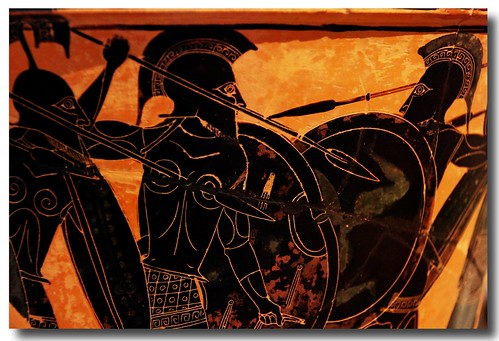
 Greek hoplites depicted on an ancient piece of pottery.


Addressing the other end of the spectrum, is a world that is in decline, such as that seen in Jack Vance's Dying Earth series. In those works, the sun is in the final stages of its life cycle and the earth is very, very old. It makes for a very bleak setting with a wash of nihilism coating everything. One of the major advantages of this kind of setting is the shear abundance of rich history and strange, inexplicable devices or ruins. Things could be present which literally cannot be explained or analyzed because there is no one alive with knowledge of the events and even the recordings of such events have long since been reduced to dust or lost to some severe catastrophe. Another interesting possibility is blurring the lines between magic and technology, so much so to the point that they are almost indistinguishable from one another, and to the people of such a world, there is no reason to understand a difference between them. For example, in Gene Wolfe's Book of the New Sun, one of the guild's in his setting uses a device that generates 'lightning' which they use for purposes of torture. Mystified, they use this 'magical' device without understanding something as fundamental as electricity. It's a paradigm-shifting concept - that, if the knowledge of what electricity is and how it acts in the universe is forgotten, we immediately revert to our ancient, natural state of clouding the unknown with the Divine. Interesting notions to consider, of course, but unfortunately, I've spent far too much time and space on this matter - much more than I wanted to. To condense all of that, I will continue my Middle Path ideology and explore elements of both. Dragonsgate will be an older world, but one that is just starting to climb another peak on the sinusoidal path of its world history. Literally starting fresh, in a way. It won't be primordial, but much of the history of the past cycles will be buried in the Substrata of Time.
Book of the New Sun, Part One  for those of you that are interested.
Moving on, I want to consider the other points that I brought to attention a couple of paragraphs ago. This is a low-magic setting, something that is easily justifiable enough considering the age of the world. Perhaps magical energy/fields/powers ebb and flow with the cycles of the earth's age. I like that notion, and I'll say that in this particular cycle, magical activity is at a low. On top of that, it is something that is safeguarded. I like the idea of magical power being a Pandora's Box, so, I'll say that unstewarded use of magical powers contributed to the catastrophe that ended the previous cycle of the world's history. The tieflings that guard the mystical well I'd mentioned in Worldbuilding 4 need to have a reason for doing so. Tieflings are not necessarily evil, so I don't like the idea of them selfishly hoarding the access to magical power for no reason other than the fact that they are vile and depraved. No, I actually think that the tieflings will be the survivors of the previous apocalyptic event, and their diabolic nature is a mark of the gods they are marked with as punishment for their hubris and misuse of magical power in the past. This simultaneously addresses points 1 and 2 and also creates a lot of mythological fodder for later.

For number 3, the status quo is always turbulent. Always. For a campaign, it can start in peace-time or otherwise stable eras, but that needs to change quickly. This is also a good rule of thumb for any fictitious story. Stable is boring. People don't read (or in the case of a game, play) something because it is static and blissful. I'm not saying that the world needs to be on the brink of utter destruction constantly (unless you're running Die Hard: the CamPAIN), but something needs to happen, and quickly. The best way to grab your players' (or readers') attention is to throw them into the deep end, fast.

In regards to (4), I say that gods will be minimally "active" in the worldly affairs - after all, they're probably jaded after seeing the world be blown up not too far ago in the past. They might keep a watchful gaze on the doings of the newest denizens of their world, but they may be waiting to see how things begin to play out. I do like the idea of them occasionally walking the earth disguised as mortals to keep informed about the health of their precious world. Also, they would probably want to keep tabs on the access to magical power to ensure that the past doesn't repeat itself. And lastly, we've already addressed points (5) and (6) with my lengthy discussion just a little while ago.

So...now that I've spent far longer just laying the groundwork for my discussion of Dragonsgate's history, I'll try to keep the rest of the post to a minimum and break it up into a second post detailing the most major events (mainly to spare you readers from going cross-eyed staring at the screen for too long).
  1. The Great Mishap. It won't be called that, but it needs a suitable placeholder name for now. This will be the event that caused the end of the previous age of the world. It needs to be sudden, violent and dramatic. I think a battle or other major threat should be involved - maybe a monster or alien entity of considerable power that was defeated only at the cost of accidentally destroying the world itself. Maybe a Cthuluesque monster or the infamous Tarrasque was responsible. It could have even been a Godzilla or Cloverfield situation. A cadre of brave spellcasters set forth to stop the threat and unleashed a Pandora's Box spell. Tragic irony. In fact, I think I have it. A powerful villain's plans were nearing the dramatic crescendo, and the world was almost in his hands; a powerful group of heroes stepped up to stand in the villain's way, calling upon potent magic to thwart their enemy. But the spell was too potent and perhaps too poorly understood. The spell succeeded in stopping the enemy, but only because a more powerful and more uncontrollable entity was summoned through the dweomer. Ultimately, this entity would probably be some sort of terrible, Lovecraftian entity that devoured the denizens of the world or reduced the survivors to madness before departing back to the Far Reaches of the Cosmos. Now that it knows the location of this world, it could return, any day, to continue its rage.
  2. The War of the Nine Wands. Not too sure where this fits, but I'm digging the name. Automatically it has something to do with magic, and the name makes it sound suitably epic and dramatic. Perfect for a major event. This does imply that it takes place before the Great Mishap, though it could also be early on in the New Era before the tieflings stake out and control access to the Well.
  3. The Northern Exodus. This could be the event that explains the concentration of nations and people around the mid-latitudes of the world. It could also be precipitated by the Great Mishap. Still, it's getting difficult to envision how new races that would have been unaffected by the Mishap would be able to spread through new areas of the world without knowledge of the previous events or era. Maybe the gods seeded new races in the New Era. I dislike the idea due to its supernatural feel, but it might be possible to "rationalize" it. I doubt it though. Maybe the tieflings created new races to act as their successors, perhaps in an attempt to seek out penance for their previous wrongdoings. Although, if I go with the Great Mishap incident, this is hardly an act worthy of cursing the individuals responsible. They acted out of good intentions, but achieved disastrous results. Perhaps the tieflings that guard the Well are not an entire community or city, but just a cadre - the original heroes that were responsible for the summoning to begin with. Maybe the survived and were punished for their crime of using forbidden magic to summon an entity beyond their control. I like that - lots of layers. It's easy to see that we're fueling a lot of mythical elements into the early history of the second age though. Oooooh. Idea. Not sure what the technology level of Era One (prior to Era Two, aka the New Era), but what if there was a 'genetic ark' of entities that were being constructed or engineered (this is starting to become a science-fantasy setting) by the previous population prior to the Mishap and the surviving tieflings used those samples to introduce new life-forms to the broken, charred world of Dragonsgate? I'm starting to feel like there's a vein of Prometheus going on here, which is all well and fine. It's worthy of exploration later, but this could explain the vast diversity of races on Dragonsgate, their relative close proximity and distribution to one another and it also creates another ethical issue for which the Precursors (tieflings) could be held responsible and judged for their 'hubris'.
  4. The First Council of Nations. From the get-go, I liked the idea of the nation of Pazu being a highly peaceful and diplomatic nation, defying the typical trope of making orcs, goblins, trolls and ogres mindless, evil and depraved entities. Given the nature of the world, I think it's somewhat appropriate to have the paradigm inverted a bit (ie. a lot). Nevertheless, it would be a landmark event to note when all the major nations of the era convened to establish general protocols and relations with one another. It's not necessarily saying that the times since the first council have been sunshine and butterflies entirely; it's more interesting that it creates the possibility for a tense, dynamic, political theatre that can create and exhibit numerous sources of intrigue and political strife or tension. Those are great plot-points for any story and create a natural way to discuss the status quo of the world.
  5. The Construction (and War of) the Librams. No idea what this is yet, but it sounds good, whatever it is (yes, these are mostly just ideas that are coming to me as I write).
  6. The Maradi incursion; the Andujan unification; the division of the crown of Algard into the Kingdoms of Seagate and Windmarch. These are a few major political/historical events that need to be discussed at length, and I'll discuss them next time.
Next time, we'll dig right into discussing these 6 points, which should give us a pretty good basis for resting Dragonsgate's status quo upon.